We are inspired by our Mount Vernon Community of students, families, and staff who are showing great resilience, determination, and creativity to stay connected with one another and to support student learning. Their efforts to continue to make Every Day Count during this unprecedented time are amazing! Teaching & Learning staff are excited to share resources and ideas for staying connected and supporting student learning. Students are likely to hear from their classmates, teachers, and school sites with ways to stay engaged. Maintaining our sense of community supports our social-emotional health and will help each of us to remain engaged in learning. We hope you engage with and enjoy the ideas we post on our Every Day Counts! student learning blog. Stay tuned--we plan to begin posting on Monday, March 23rd! Many of the resources we will be sharing are available to all students via the MV TECHSMART K-12 DIGITAL LITERACY site.


Showing posts with label Math. Show all posts

Thursday, June 18, 2020

Wednesday, June 17, 2020

6-17-2020 Finding Patterns


Above are Figure 1, Figure 2 and Figure 3.
How many total blocks are in Figure 3?


Can you sketch Figure 4 ?
Can you draw Figure 10?
How would you describe this pattern to your friend, using words, pictures or equations?

Mary Ellen Huggins: Mount Vernon Schools Teaching and Learning

Thursday, June 11, 2020

6-12-2020 Never Ending Pasta

pasta-passOn September 15, 2016, Olive Garden again offered a $100 pass for never-ending pasta, bread sticks, salad and coca cola soft drinks.  The 21,000 patrons who quickly (in less than a minute) bought all of the passes will be entitled to as much pasta as they like (with toppings) from October 3 to November 20.  Ask the class to consider these questions:

  • Is this a good deal for patrons?  What are the pros and cons?
  • Will Olive Garden go broke?
  • Is this good for the restaurant chain?
  • Is the pass priced correctly?  If not how much should it cost?
  • How should we start answering these questions?  What information would be useful?

What information will you gather in order to analyze the money-making, money-saving, or money-losing potential of this Pasta Pass?

The activity:  all-you-can-eat-pasta2016.pdf

Yummy Math

Martha Thornburgh: Mount Vernon Schools Teaching and Learning

6-11-2020 Learn How to Make a Paper Balloon

Practice the art of Origami and learn how to make a paper balloon.  


Find out more about this activity and learn more about how different shapes are used in architecture at this link.  

  • How could you decorate your balloons? 
  • Try different sizes. 
  • What other shapes can you create with Origami? 
Martha Thornburgh: Mount Vernon Schools Teaching and Learning

Monday, June 8, 2020

6-9-2020 Microns and Masks

How big is one coronavirus? How big is a micron? How well do these masks protect against the virus? What can you observe about the size of particles mentioned? Why are we wearing masks?

Click on this link to see the resources and do the activity.  HowBigMicron.pdf

Activity from YummyMath


Martha Thornburgh: Mount Vernon Schools Teaching and Learning

Tuesday, June 2, 2020

6-2-2020 More Toothpicks

More Toothpicks and Squares


How many toothpicks do you need to make one square?

4

How many toothpicks do you need to make two squares?


Three squares?


What pattern do you notice?


Can you predict how many toothpicks you will need to make nine squares? 


Extension:


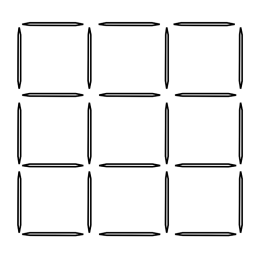
Given three squares:


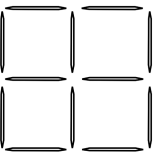
Below are four squares. Can you move two of the toothpicks so that you can have seven squares?


Mary Ellen Huggins: Mount Vernon Schools Teaching and Learning


Thursday, May 28, 2020

5-28-2020 Scrabble Math

SCRABBLE MATH


K

The “M” tile has the number 3 on it. Can you start counting at 3 and count up to 42?


Grade 1

There are about 46 tiles in the picture. Can you start counting at 46 and count up to 120?

Grade 2

Use the digits on the tiles to create 2 numbers with a sum or difference close to 100.

Grade 3

The”M” tile is worth 3 points. How many 3’s are in 18? 

How many 3’s are in 24?

Grade 4

Using all the digits on the tiles, what is the greatest number you can make? Write it in expanded form.

Grade 5

Use all of the digits on the tiles and a decimal point to create two numbers with a sum or difference close to 2.55.

Extension

Find other scrabble pieces and create your own questions for family members of students in your class.  If you do not have a Scrabble board game, look up scrabble letters on Google.


Mary Ellen Huggins: Mount Vernon Schools Teaching and Learning

Friday, May 22, 2020

5-22-2020 Toothpicks and Squares

Toothpicks and Squares


This is a square made of toothpicks.  If you have toothpicks at home, you can make your own model or you can draw it on a piece of paper. 

There are a lot of different items that you can count.


Here is the start of a list:


Item

Number

Squares that measure one by one 


Toothpicks


Corners (spaces)


Squares 


Columns


Can you think of other things to count?


Mary Ellen Huggins: Mount Vernon Schools Teaching and Learning

Thursday, May 21, 2020

5-21-2020 Learn to Cook While Learning Math

Check out these great resources with recipes and ideas for learning how to cook and learning lessons while cooking.  


 Make flour 1080P, 2K, 4K, 5K HD wallpapers free download ...

Sign up for the  ChopChopFamily.org Kid Club Newsletter to get great ideas for cooking and learning together as a family.  Check out Volume 6 where you learn how to make bread.  In addition to making bread there is a cool science experiment with yeast and some suggestions for great read aloud book pairings. 


Another great resource is DREME Family Math Cooking.  Add and Subtract while making pancakes.  Measure while making Macaroni and Cheese, Count while making berry smoothies and so much more.  This resources is available in English and Spanish.  

Martha Thornburgh: Mount Vernon Schools Teaching and Learning

Tuesday, May 19, 2020

5-20-2020 How Many Do You See?

HOW MANY DO YOU SEE?

HOW DO YOU SEE THEM?


Generally, there is between ¼ and ⅓ cup of juice in one orange.

About how much juice would half an orange produce?

How much juice could all of the oranges in the picture produce?

This number line might help you!

Mary Ellen Huggins: Mount Vernon Schools Teaching and Learning

Monday, May 18, 2020

5-19-2020 Race to 21

RACE to 21

Here is a fun, quick counting game called Race to 21. It is for all ages and there are some strategies that you will soon figure out.

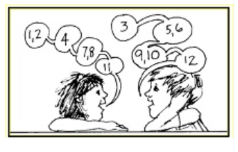
The game is for 2-4 players.  In this game, players take turns counting up to three numbers beginning with 1 and working their way up. Whoever lands on 21 is eliminated and the next round begins with one less player. The remaining player is the “winner”.  


Here is a sample game.

Player 1: 1,2

Player 2: 3,4,5

Player 3: 6

Player 1: 7,8,9

Player 2:10,11

Player 3:13,14,15

Player 1: 16,17,18

Player 2: 19,20


Player 3 would then have to say 21 and would be eliminated. Player 1 and Player 2 would start another game.


You can mix up the game by 

  • changing the Target number to 31, 50 or 100 if you wish

  • Counting out up to two numbers or up to four numbers


Experiment and see if your strategy has to change in order to have your partners choose the final number.


Mary Ellen Huggins: Mount Vernon Schools Teaching and Learning

Monday, May 11, 2020

5-12-2020 Number Line Scavenger Hunt

Number Line Scavenger Hunt


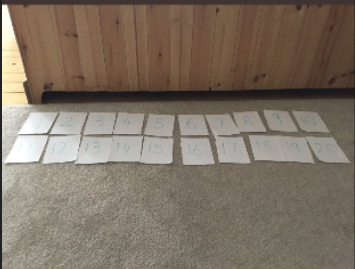
Scavenger Number Line Hunts are fun for those hiding numbers and those finding the numbers. This game can be played with a parent or a sibling or anyone else in your home.


  1. Using sticky notes or small pieces of paper, cut out numbers from 1-20 or fractions from ½ to202, or decimals from 0.1 to 2.0...you choose.


  1. Have a parent or sibling randomly hide numbers throughout your home.  


  1. Next, go on a hunt to find all the numbers.  


  1. Once you have found all the numbers, place them in a number line.


Mary Ellen Huggins: Mount Vernon Schools Teaching and Learning

5-11-2020 Street Maze

It’s a Street Maze


On a sunny day, it is nice to play a big outside board game, such as Street Maze.


Draw a board on your sidewalk or a piece of large cardboard that has five rows and five columns.  Place the numbers you see in the picture above in corresponding boxes.

To play for 1-2 players.  Youngest person goes first!

  1.  Start on the 1 in the bottom center square.

  2.  Then jump 1 space in any direction (Forward, Backward, Left or Right) but NOT diagonal.

  3.  You can choose to jump in any direction the number of squares indicated by the square you're standing on.

  4.  Your aim is to reach the heart on the  last jump of any given turn.

  5.  See how many different pathways to the heart center you can find.

  6. Make your own maze and share with your friends.


Mary Ellen Huggins: Mount Vernon Schools Teaching and Learning

Monday, May 4, 2020

5-4-20 Triangle Designs

Triangle Designs
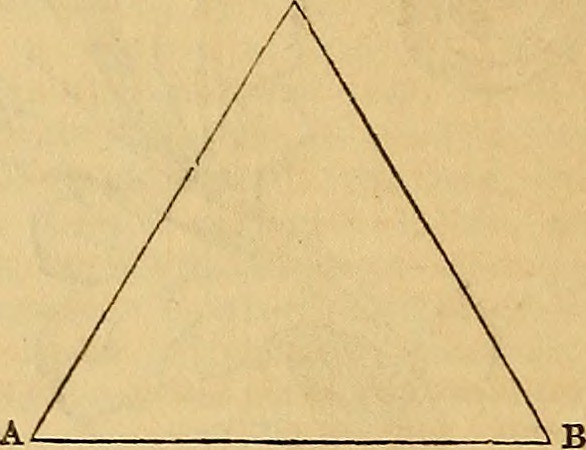
 The goal is to create as many composite shapes as possible made up of four isosceles triangles.
 

  1. Cut four isosceles to make your shapes.
Remember that isosceles triangles have two sides of equal length.
  1. Use the triangles to make different shapes.  
  2. Each triangle mus touch at least one other triangle
  3. Triangles must touch along sides of the same length.
  4. See how many you can make.


Here are some examples
Mary Ellen Huggins: Mount Vernon Schools Teaching and Learning

Monday, April 27, 2020

3-28-2020 How Many?

How Many?


What do you notice?
What do you wonder?

Some things to notice:  

There are oranges in the picture.
Some oranges are cut in half.

Some things to wonder

How many halves are in the picture?
How many oranges are in the picture?

Can you find some other things to notice and wonder?
Which question do you want to answer?

Can you explain your answer using pictures, numbers and words?

Mary Ellen Huggins: Mount Vernon Schools Teaching and Learning

Thursday, April 23, 2020

4-23-2020 Four 4's

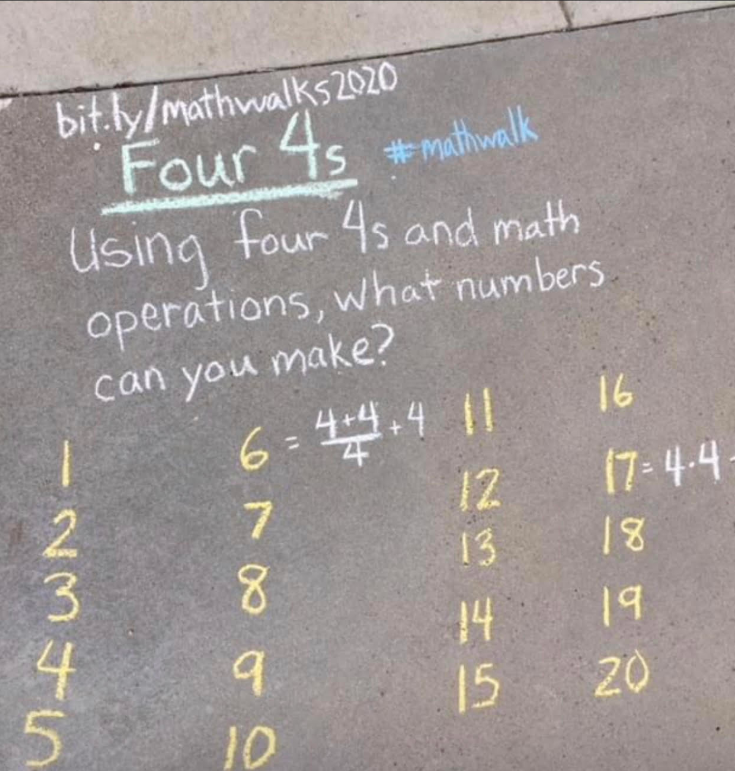
Four 4’s


You can do this on a piece of paper in your journal or by using chalk on a sidewalk.  Using the number 4 four times for each number and the math operations+, -, x,or, to find the numbers 1- 20.
 If you want to add or ( ) such as 4(4 + 4) 4 = 8 or
fraction values such as 44 to equal 1 or  exponents 44to equal 16, you may do that. Just remember you have to use four 4’s to make each number: 1 to 20.  See how many you can make.

Mary Ellen Huggins: Mount Vernon Schools Teaching and Learning

Tuesday, April 21, 2020

4-21-2020 Counting Donuts

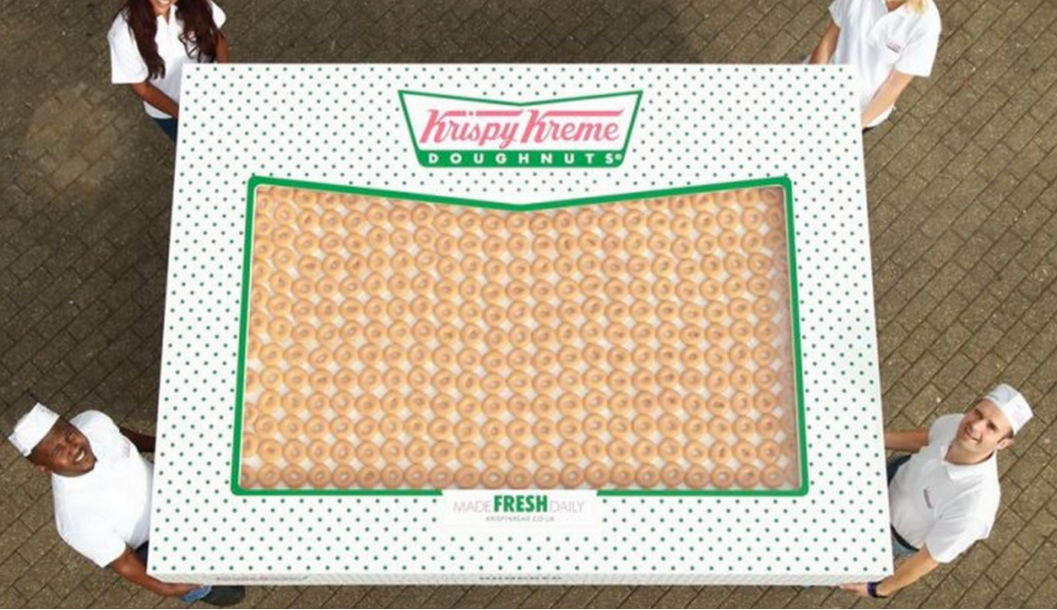
A Krispy Kreme Donut shop in the United Kingdom made an extremely large box for its donuts. Can you figure out how many Krispy Kremes are in this box? LINK


  1. How many donuts do you think are in the Krispy Kreme box?
  • In your journal, make an estimate.  Explain how you made your estimate.
  1. Here is some additional information you might use to solve the problem


Email from the UK:
Here is some information that might help you with determining how many donuts are in the enormous Krispy Kreme box.
The box holds three layers of donuts. Each donut has a diameter of 89 millimeters (mm). The box measures 3000 mm by 2300 mm.

  • Decide what information you will use to solve the task.
  • Choose a strategy to determine the answer
3.
  • Compare your work to the actual answer in ACT 3
  • How close to your original estimate is your answer?
  • Why do you think that is?
Mary Ellen Huggins: Mount Vernon Schools Teaching and Learning